
I've been pondering where AI is headed. Not next quarter or next year. Beyond that.
Here's where I keep landing. AI will become self-directed, self-correcting, and self-governed. It will also be ambient, non-intrusively involved in our personal and professional lives.
Follow that thread far enough for our professional lives and you arrive at a new kind of company. I'm calling it the Autopoietic Enterprise. The destination seems inevitable to me. The arrival time does not.
Autopoiesis
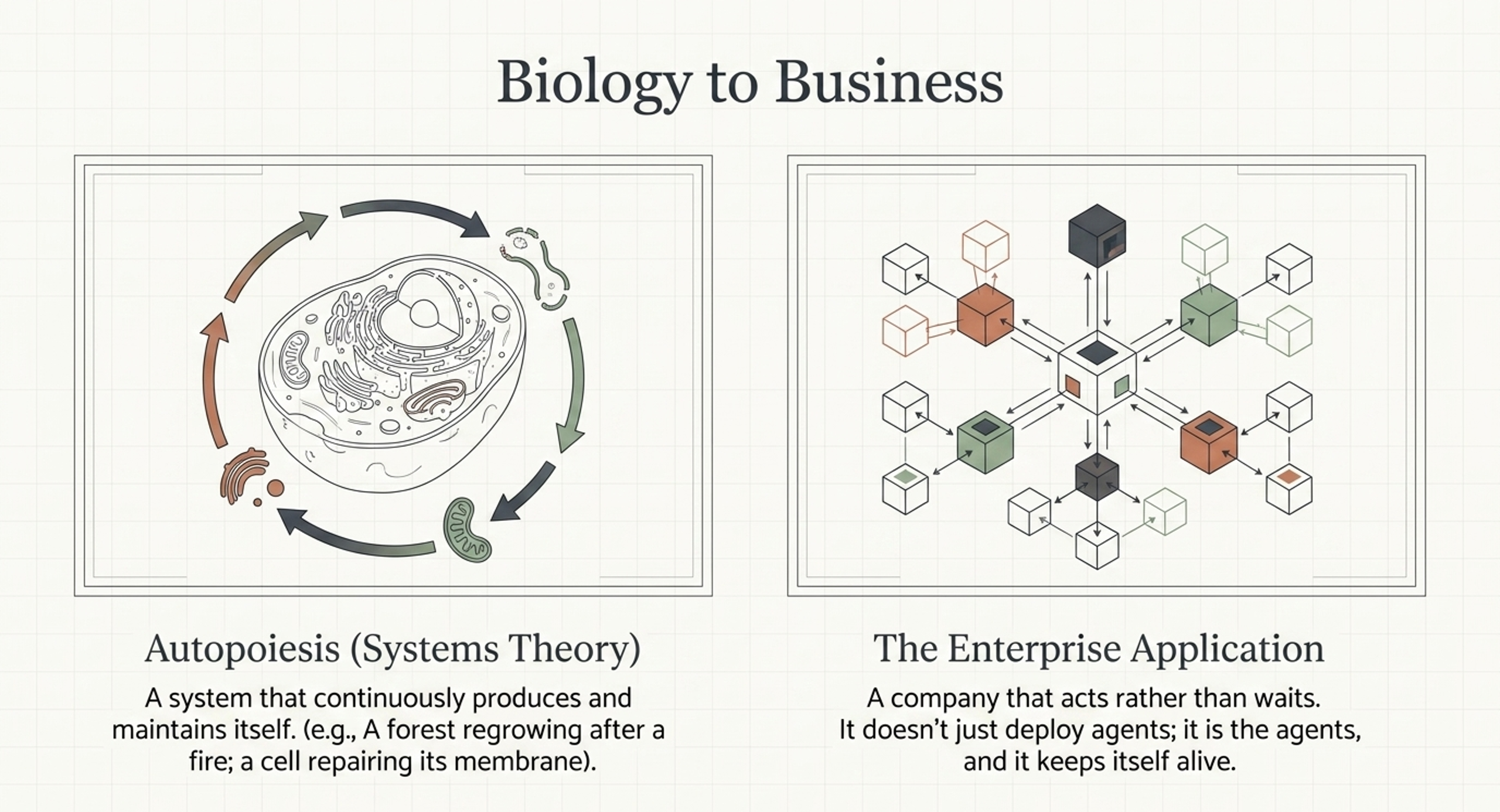
Autopoiesis comes from systems theory and biology. It describes a system that continuously produces and maintains itself. A cell repairing its own membrane. An organism regulating its own temperature. A forest regrowing after a fire.
These systems need inputs (e.g. a forest needs rain and sun), but they act rather than wait to be acted upon. The environment supplies raw inputs/materials. The system decides what to do with them.
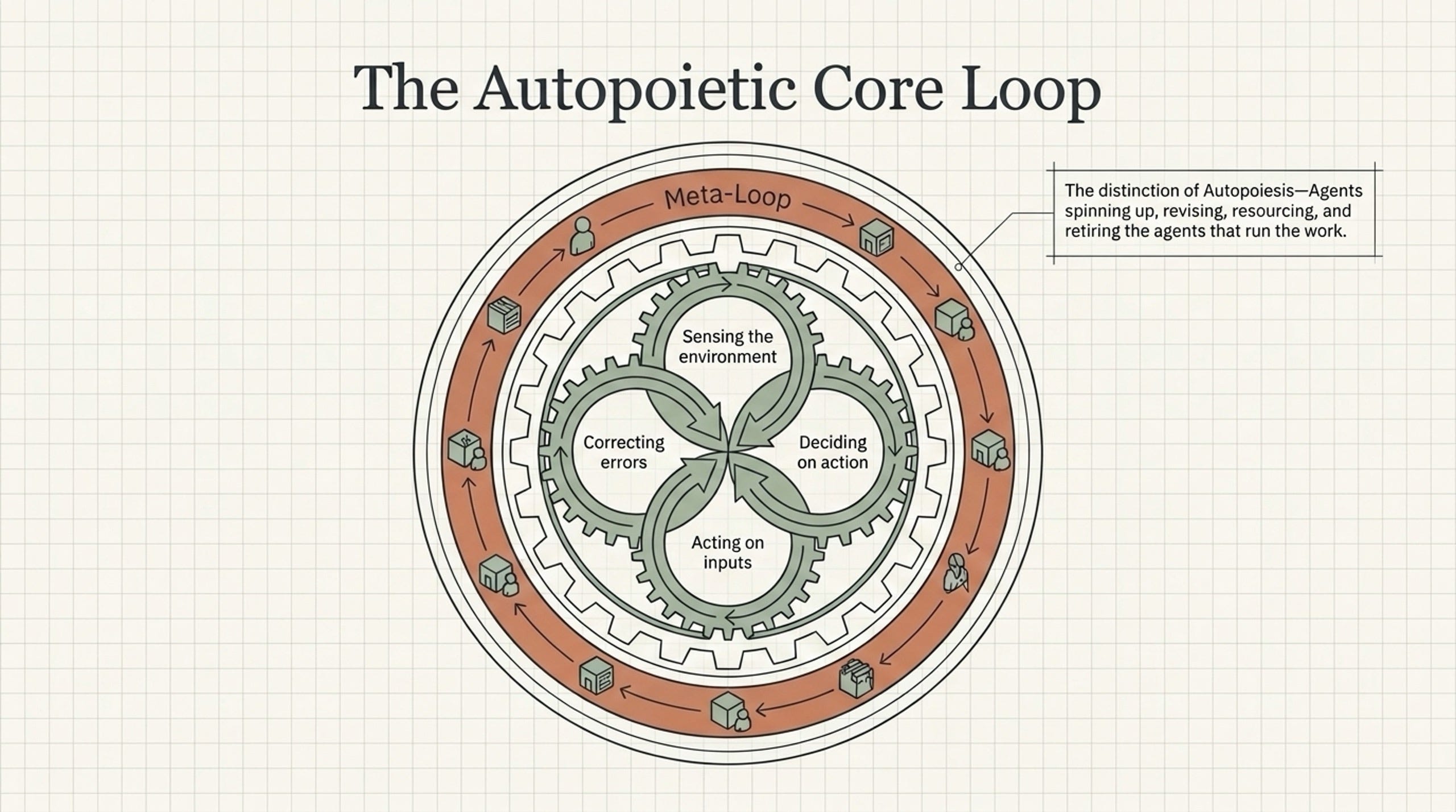
Now apply that to a company. An Autopoietic Enterprise runs its core loop by sensing, deciding, acting, and correcting, on agents rather than people. The agents notice the problem. The agents fix the problem. More than that, the agents produce and maintain the other agents. The enterprise doesn't just deploy agents. It is the agents, and it keeps itself alive.
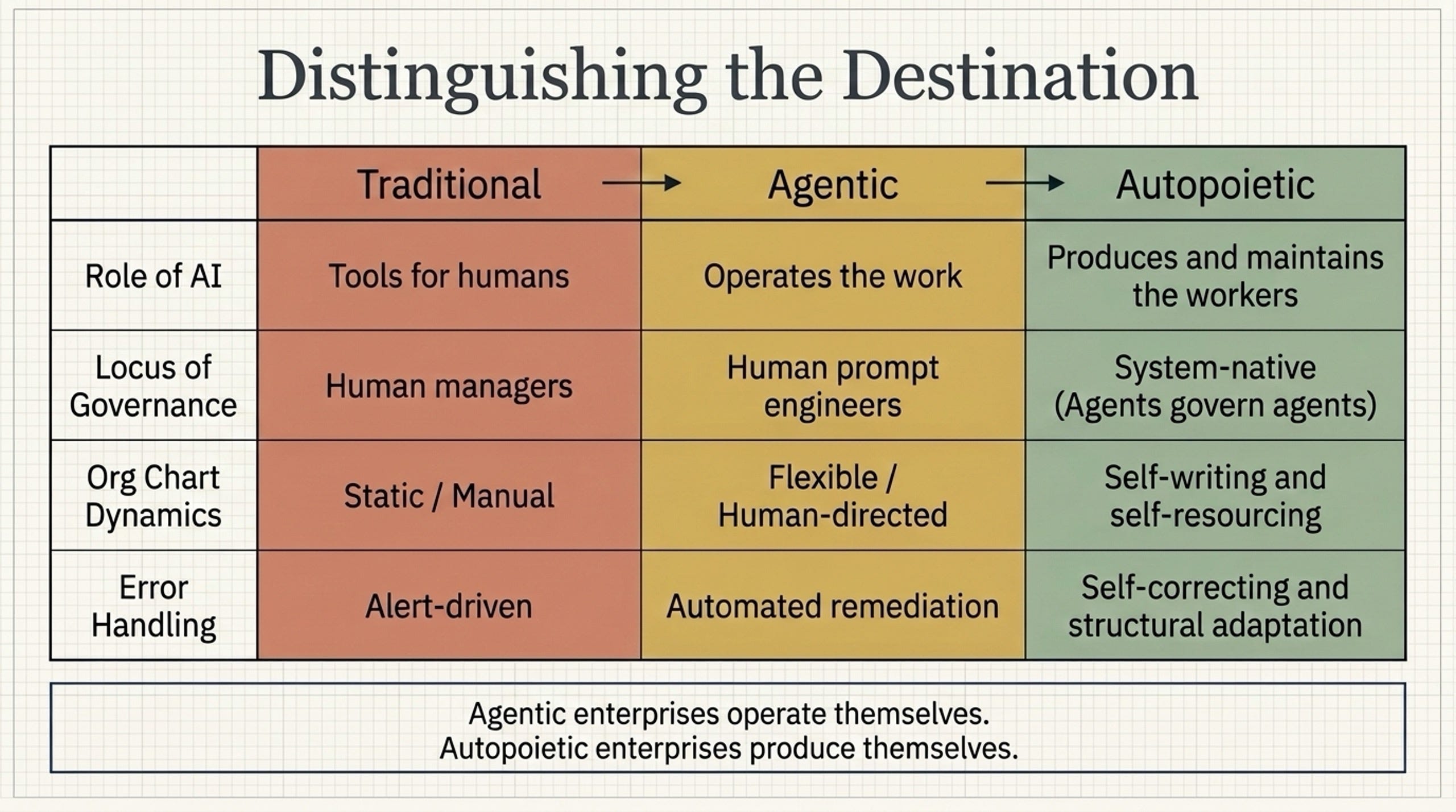
This is where the term does real work, so let me be precise. There has been a lot written about the autonomous or agentic enterprise. Those describe a company that operates itself. Autopoiesis claims something stronger, a company that produces itself. The agents spin up, revise, resource, and retire the agents that run the work.
The org chart becomes something the system writes and rewrites on its own. That closure, a system that makes its own components, is the distinction, and it's the part I find most interesting.
The characteristics
These Autopoietic Enterprises will have distinctive characteristics, and I don’t believe I have the full list of them yet. I’m thinking out loud, and that’s part of why I’m publishing this (I welcome your input). Four feel foundational, and they split into two groups.
Three describe how the enterprise runs on the inside.
● Self-directed. Agents initiate work from goals and signals, not prompts. Nobody asks. Work simply moves.
● Self-correcting. Failures get detected, diagnosed, and repaired from within. We already see early versions in infrastructure, where agentic systems resolve most incidents without a human touching a keyboard.
● Self-governed. Agents govern agents, within policies humans define. Guardrails, escalation, auditability. Governance becomes a function of the system rather than a layer of managers.
The fourth describes how it meets the world.
● Ambient. The enterprise and its products don’t demand attention. They sit context-aware and quiet, surfacing value at the moment it’s needed rather than waiting to be summoned.
The characteristics of the agents become the characteristics of the enterprise, and then of the products it ships. It’s turtles all the way down.

Why I believe this is coming
Two structural forces convince me.
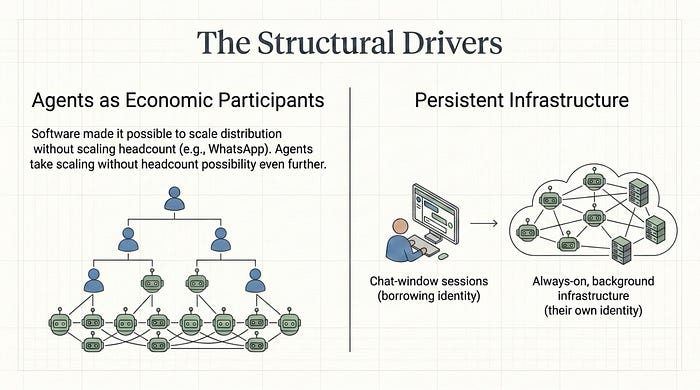
The first is that agents are becoming a new class of economic participant, not just better tools. Software already lets companies scale distribution without scaling headcount. As an extreme example is WhatsApp reaching hundreds of millions of users with dozens of employees. What’s new is that agents let a company scale the work itself, the operations and the judgment, not just the distribution. That link between output and headcount is the one breaking now.
The second is that some of the most important agents won’t be the visible ones. Many of today’s agents live in a chat window and borrow a human’s identity and permissions. The pattern that matters runs in the background, holds its own identity, and keeps working when no human is present. The assistant stops being a session you open and close. It becomes standing infrastructure, always running.
Put those together. Persistent agents, plus agents as participants, plus agents that produce other agents and you have an enterprise that runs and remakes itself. The timing is the open question, not the direction.
Today versus tomorrow
Here’s the argument for why this reaches all the way, and not just to more automation.
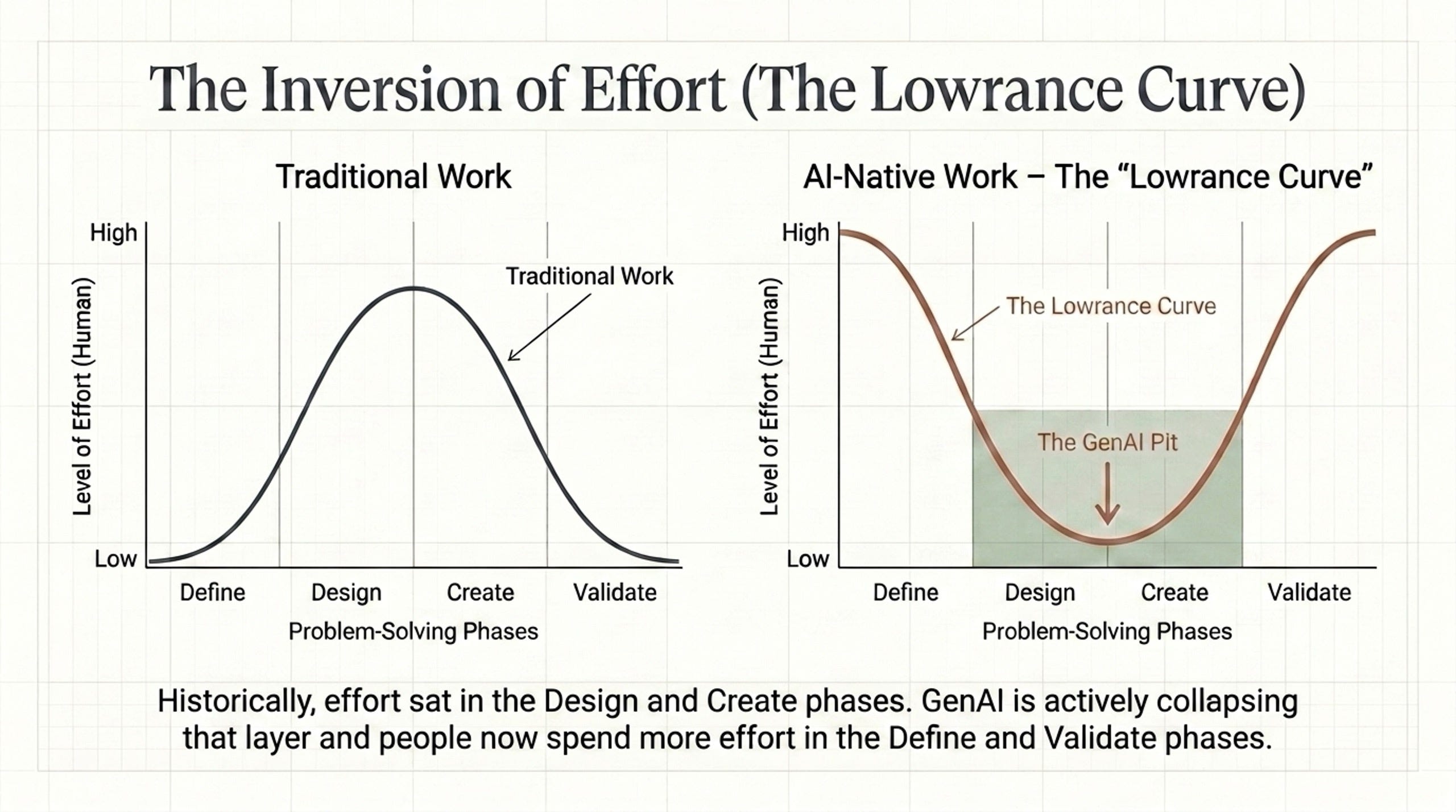
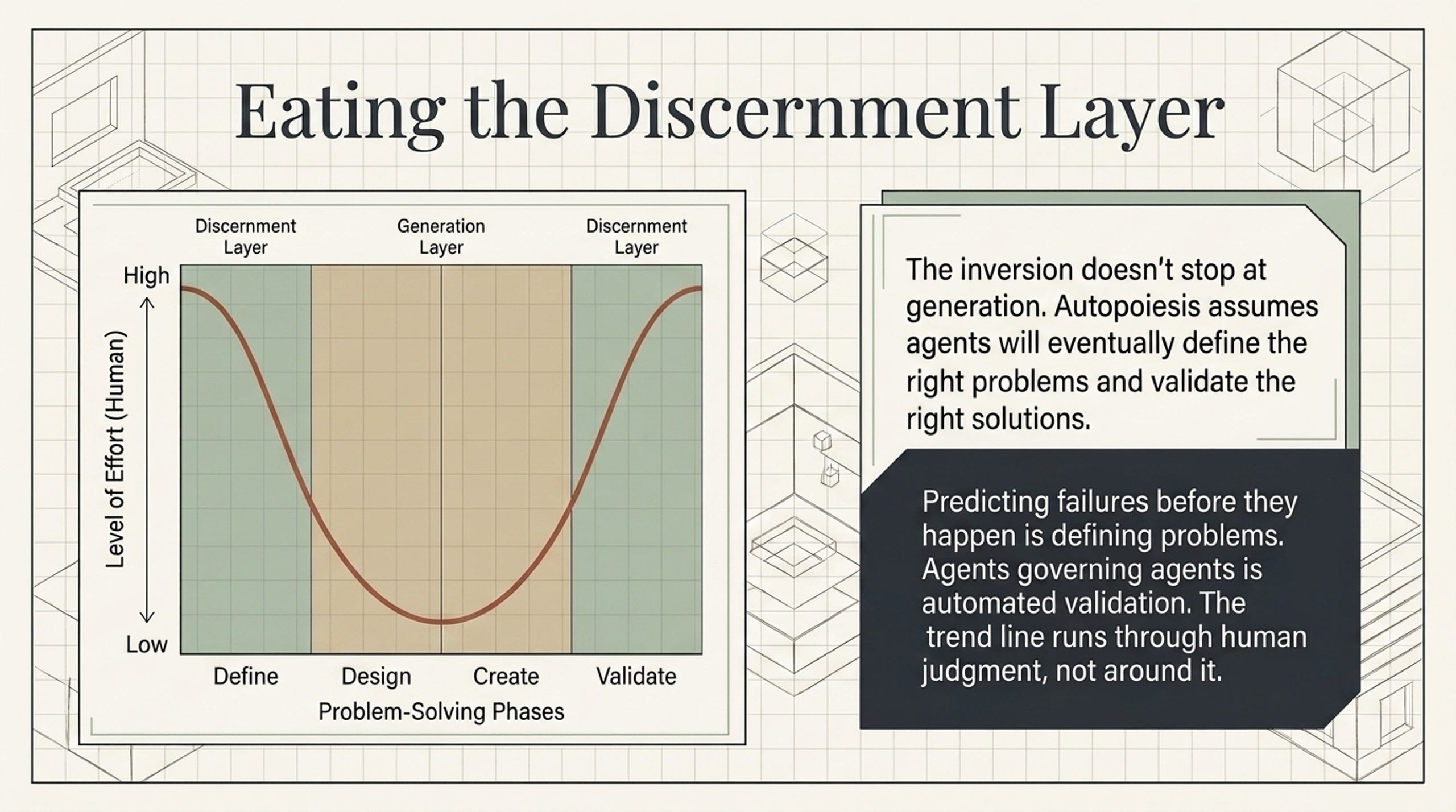
A founder recently introduced me to the Lowrance Curve. It describes how the shape of work is changing. Historically most effort sat in the generation layer, designing and creating solutions. AI is collapsing that layer. The effort is inverting toward the discernment layer, defining the right problems and validating the solutions that get produced.
For now, discernment is where humans add the most value. The Autopoietic Enterprise is the claim that the inversion doesn’t stop there. Over time, agents move into the discernment layer too. They define problems and validate solutions, not just generate them.
Is that a wild leap? Look at the emerging signals. An agent governing another agent is a sliver of discernment. A system that predicts failures before they happen is defining problems, not just fixing them. The trend line doesn’t run around human judgment; it runs through it.
That’s what makes me think the endpoint is a company where even discernment is largely self-acting, however strange that is to picture.
Early glimpses
No true Autopoietic Enterprise exists today. But there are rough, ugly first drafts.
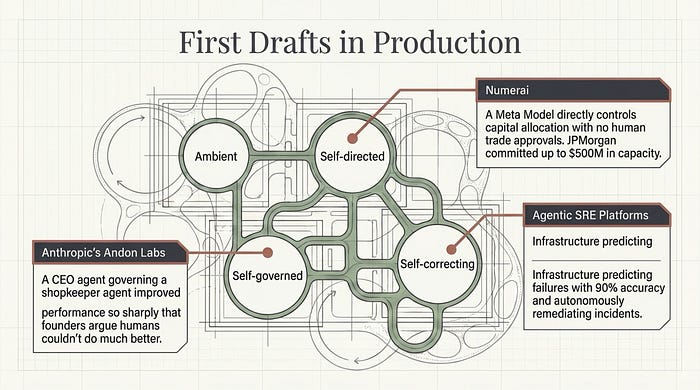
Andon Labs ran an AI-operated shop inside Anthropic’s office, an experiment that began as Project Vend. Version one failed constantly and hilariously. Then the system added an internal governance layer, one agent acting as CEO over another acting as shopkeeper, and performance improved sharply. A year in, its founders argue humans wouldn’t do much better. That’s self-governance emerging inside a working business.
Numerai runs a real hedge fund where a single Meta Model, assembled from thousands of crowdsourced ML models, controls capital allocation directly. No human trader approves individual trades. JPMorgan committed up to $500 million in capacity anyway.
And in infrastructure, agentic SRE platforms now predict failures with roughly 90% accuracy and remediate most incidents on their own. That’s self-correction running in production today. None of these is the full picture. Each one automates a different slice of the loop, and together they rhyme with where this goes.
How this relates to investing
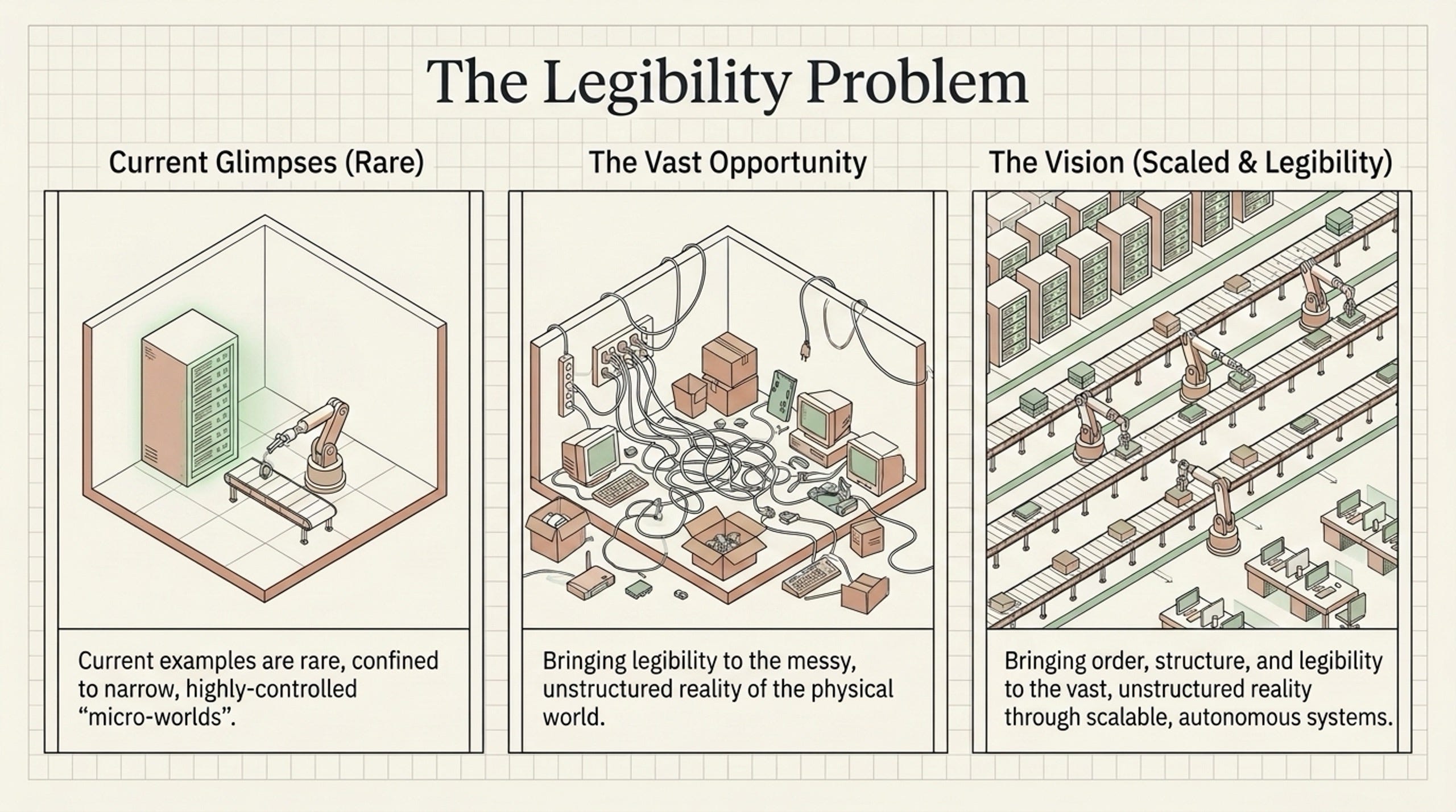
Notice what those glimpses share. Each lives in a narrow, richly instrumented world. A stocked shelf. A market with clean price feeds. A data center wired with telemetry. Autopoiesis is easy when the environment is already legible to software.
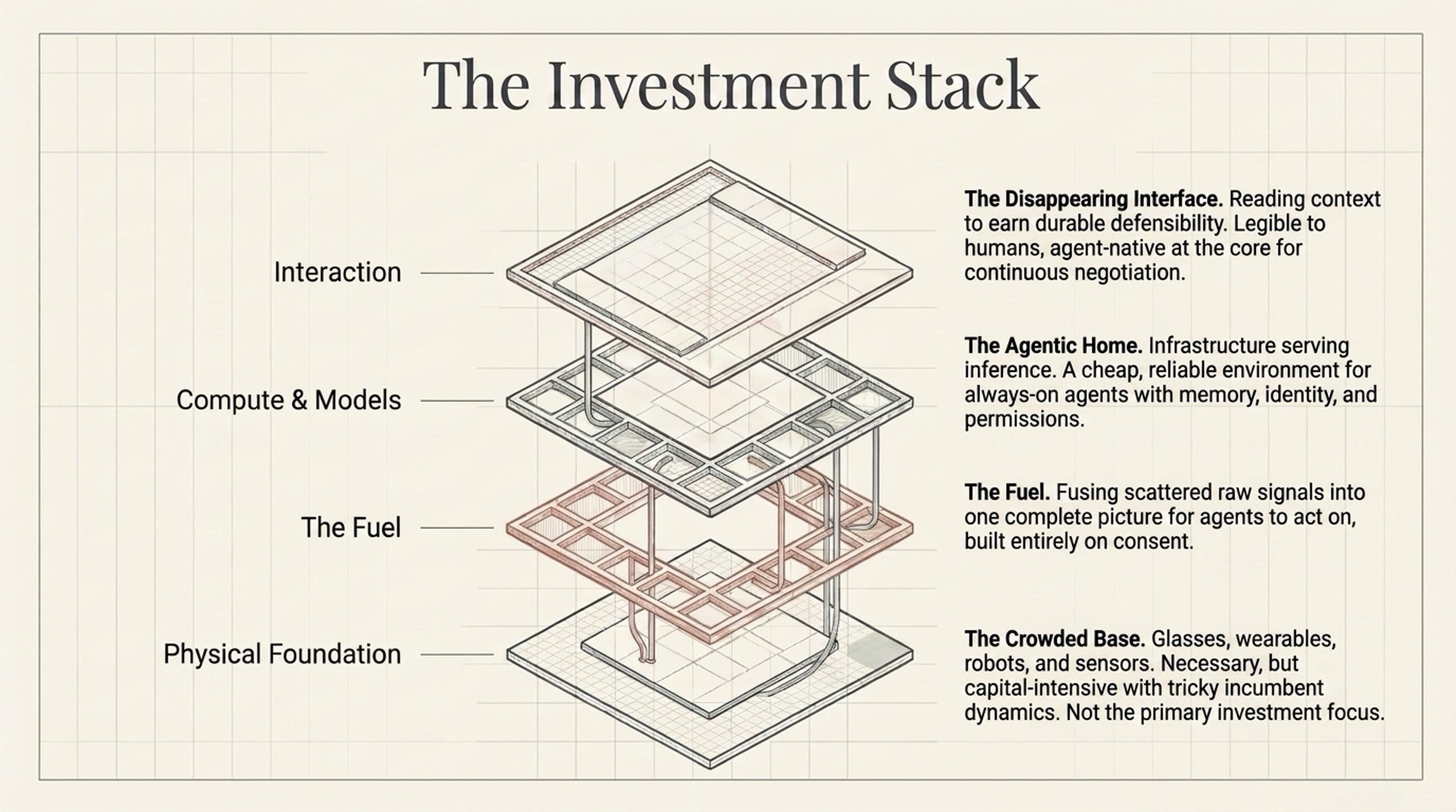
The opportunity to create an economy full of Autopoietic Enterprises requires many elements. For simplicity I’ve broken these elements into four layers: hardware, compute, data, and interaction. All layers are worthy of investment.
Hardware — such as glasses, wearables, robots, cameras, sensors, and vehicles — will get a lot of headlines and, I suspect, a fair amount of attention from capital allocators. The physical hardware needs to be built, but it is a crowded space, is brutally capital-intensive, and there are tricky incumbent dynamics. Physical hardware is unlikely to be my investment focus area. I’d prefer to invest in whoever turns the pile of devices into a single, reliable, always-on sensing surface.
Compute is the layer most people assume is settled. The belief being that training frontier models is a contest of capital and energy and that the labs and hyperscalers have this locked up. But compute is not one market. The layer beneath, the infrastructure that serves inference and gives always-on agents somewhere cheap and reliable to run, is still being built. Persistent agents that spin up and retire other agents, and hold their own memory, identity, and permissions, need a home optimized for exactly that.
The interaction layer interests me. Ambient only works if engaging a system feels continuous and native instead of a stream of prompts and taps. Whoever makes the interface effectively disappear, reading context and subtle cues rather than waiting for commands, will earn durable defensibility and my attention.
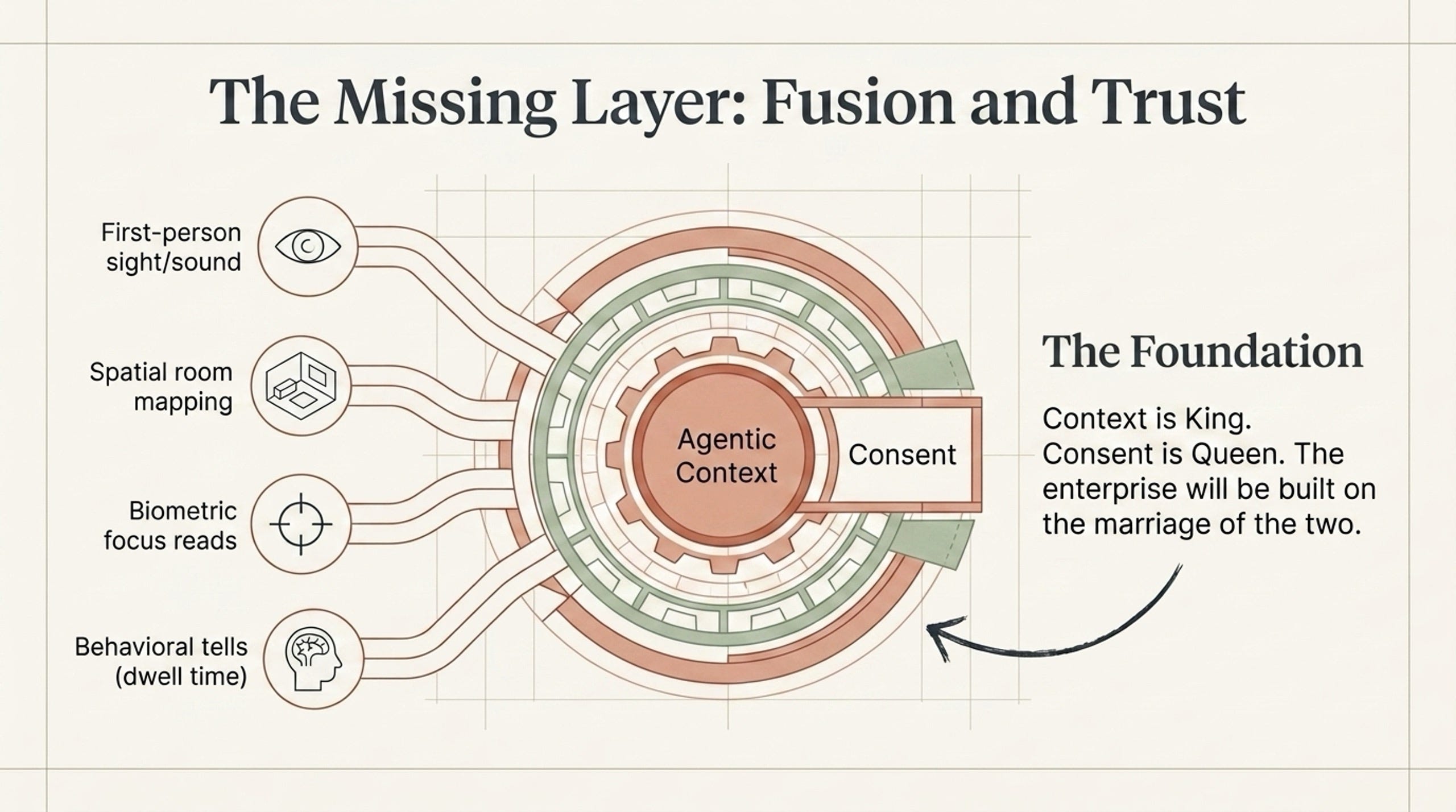
Data is the layer I find most compelling. The raw signals already exist, and will keep multiplying, scattered across cameras, wearables, spatial sensors, and the exhaust from endless software. The prize is fusion and trust. Picture what an agent would need to truly act on your behalf: first-person sight and sound from what you’re looking at, the spatial map of the room you’re standing in, the biometric read on whether your brain is focused or exhausted, the quiet behavioral tells like hesitation and dwell time, and the running context of which app, file, and device you touched last. Today those data points live in separate silos. There is a massive prize for whomever is able to stitch it all together into one picture complete enough for an agent to act on, and with the consent to do so. With respect to data, context is king and consent is queen. A marriage between the two will be the foundation every Autopoietic Enterprise is built on.
Interaction is where it comes together. Initially the subtle contextual data cues these interfaces read will be human oriented: voice, gaze, gesture, etc. But that is the early form. In a mature Autopoietic Enterprise the dominant interaction isn’t human to agent at all, it’s agent to agent, systems negotiating, delegating, and correcting each other continuously with no person in the exchange. The winning interfaces have to be fluent in both, legible to the human at the edges and agent-native at the core.
So, concretely, I’m most interested in the connective tissue, the fusion-and-trust layer that makes a messy environment legible to agents. If that’s what you’re building, or you know who is, that’s a conversation I want to have.
The honest caveats
This whole concept or thesis has holes that should be examined. Here are the ones I feel most.
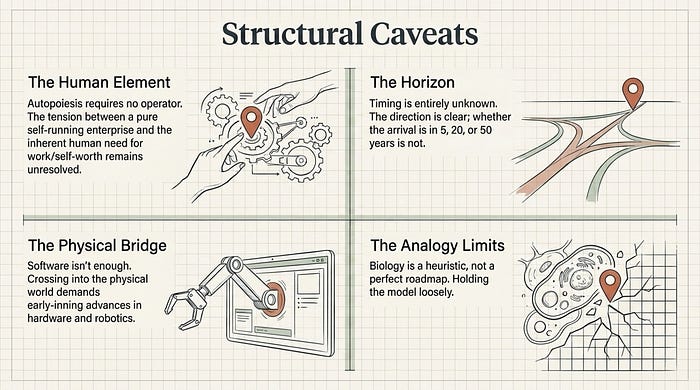
First, people. The purest version of this idea is unsettling, because autopoiesis has no operator. A cell has no manager. Organisms don’t report before regulating themselves. Forests aren’t given direction to regrow. Taken to its logical end, a fully Autopoietic Enterprise has no human in the loop at all, including in the discernment layer I described. I don’t know if reality lands in a true form or somewhere short of it, and I won’t pretend the tension between a pure Autopoietic Enterprise and people resolves cleanly.
I believe work is good for people. It breeds self-confidence and self-worth. As a religious person, I also believe human worth is not a function of output, and that we too often conflate the two. If work as we know it thins out, that belief is exactly what has to carry the weight. I can’t fully reconcile the human question with this vision yet. While the vision seems inevitable the lack of a human in the loop unnerving.
Timing is the second caveat. True Autopoietic Enterprises are not near term. Whether the horizon is five years, twenty, or fifty, I don’t know. I only know the direction, and I’m convinced of it.
Third, software alone won’t get us there. Every enterprise touches the physical world, sometimes obviously and sometimes not. Crossing from software into physical AI will take real advances in hardware and robotics. Those advances are underway, but we’re in the early innings.
Last, I am not a biologist. I came across autopoiesis while researching about systems which are self-directed, self-correcting, and self-governing. Admittedly my understanding of autopoiesis is somewhat sophomoric, but it seems to describe the future I’m envisioning quite well. There are surely other analogies that can be used. This one is the best I’ve found.
Let’s talk
This is a working thesis, not a finished one. If you’re a founder building at any layer I’ve described or have a product that aims to help self-directed, self-correcting, and self-governing systems then I want to hear from you. If you’re an investor backing companies that rhyme with thesis, let’s compare notes. Push on my thinking. Add characteristics and ideas I’ve missed. Tell me where my thinking can be improved. Help me figure out the people question, because that’s where I’m least settled.
If the Autopoietic Enterprise is coming, and I think it is, it will touch everyone. Let’s shape it together.